
VMO2 - CAPEX Remains The Main Variable - Model Update
All,
Please find our updated analysis on VMO2 here.
Note: Beta testers can check VMO2 on the portal here.
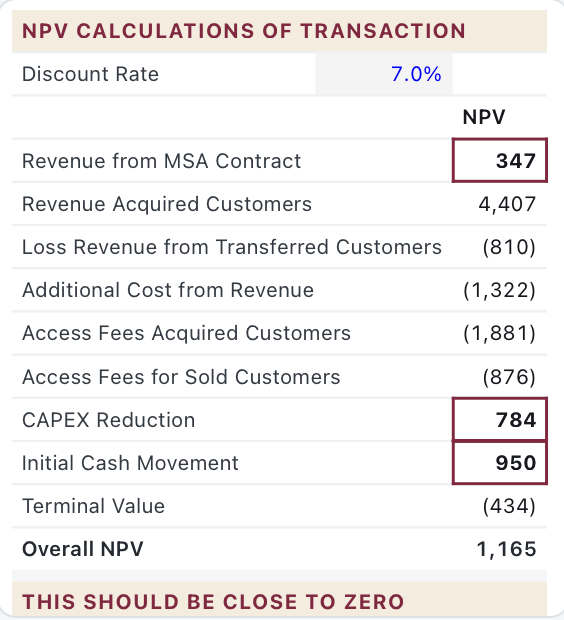
Although the finer details of the Nexfibre transaction have not been released, we have attempted to isolate the constituent parts of the deal to better understand the impact on VMO2. We have modelled the higher access fees, lost revenue and earnings from transferred customers against the upfront cash proceeds, lower network CAPEX and larger customer base. We reiterate our initial view that the transaction is a net positive for VMO2, with our analysis adding further weight to this conclusion.
Investment Discussion
We are not currently taking an active position in VMO2, although we are considering an investment, particularly in the Vendor Notes and Senior Notes. Before committing capital, we want to clarify several assumptions around the Nexfibre transaction with the Company. Our current model indicates meaningful value creation, but the outcome remains highly sensitive to the wholesale access economics and therefore warrants further confirmation.
VMO2 remains strategically important to the UK telecoms market, with a large fixed and mobile customer base, significant network infrastructure and national scale alongside BT/Openreach. This strategic position, combined with long-dated maturities and substantial recurring cash flows, provides an important underpinning for the credit. We therefore see more value in the bonds than the headline leverage would suggest, particularly further down the capital structure.
However, the DCF and debt capacity do not currently support an investment at the top of the capital structure. The DCF remains highly sensitive to terminal CAPEX, and we are reluctant to base an investment on the repeated telecom assumption that CAPEX will fall after another few years. At an elevated cost of capital, the hard reality is that VMO2 remains over-leveraged. Debt capacity based on EBITDA less CAPEX shows a similar picture, with our calculations implying only a 66–80% recovery for Senior Secured lenders.
The near-term catalyst for bond pricing is therefore the Nexfibre transaction. Our initial analysis suggests meaningful value through the upfront cash proceeds and lower network investment, but the economics depend heavily on wholesale access fees and the number of customers ultimately migrated onto the Nexfibre network. We therefore want to validate these assumptions before committing capital.
On balance, we see scope to establish a position if the transaction economics are confirmed and pricing remains attractive. The Vendor Notes and Senior Notes offer more potential upside than the Senior Secured debt given their position in the capital structure and the potential for strategic and asset value to provide downside support. The key question is therefore what price adequately compensates for the leverage, CAPEX and structural risks.
For now, we remain cautious. Leverage remains at the top end of the 4–5x range, with ICR below 1.4x. Without greater confidence that CAPEX can sustainably decline, these metrics do not provide sufficient comfort to take a position.
Nexfibre/Netomnia Transaction
The immediate benefits of the transaction are clear. VMO2 receives £1.1bn of cash, reduces the network CAPEX it needs to fund, gains access to a significantly larger fibre footprint and acquires c.500,000 customers. Nexfibre, in turn, gains the scale and anchor traffic required to become a credible national challenger to Openreach.
The key question is the trade-off. VMO2 exchanges some of the economics of network ownership for wholesale economics and will subsequently pay for access to infrastructure it previously owned. The value of the transaction therefore depends heavily on the wholesale access fees, the value of VMO2’s 15% stake in Nexfibre and the extent to which lower network CAPEX offsets future wholesale payments.
We quantify these trade-offs by calculating the NPV of the individual components of the transaction. Under our current assumptions, we calculate a combined NPV of c.£1bn.
Recent Results
The apparent improvement in fixed trading has reversed, with consumer fixed-line losses increasing to 29,900 and broadband losses to 28,200. Fixed ARPU fell 4.6% to £46.56, suggesting competition is increasingly being absorbed through lower pricing as well as customer losses.
Mobile was comparatively resilient, with consumer mobile ARPU broadly stable and only modest contract losses, while wholesale continued to grow. The weakness was therefore concentrated in the core consumer fixed business.
Service revenue fell 3.9% and EBITDA declined 2.9% to £975m. The EBITDA margin improved as lower-margin Nexfibre construction revenue fell away, but this should not be mistaken for underlying operating improvement.
The key takeaway is that the fixed-line recovery seen in Q1 has not held. With CAPEX still guided at £2.0–2.2bn, interest consuming a significant proportion of EBITDA and shareholders still targeting c.£200m of distributions, there remains limited scope for organic deleveraging.
This is particularly important for the credit, as there is now less evidence that the business can grow out of its leverage. Instead, VMO2 remains increasingly reliant on cost savings, lower future CAPEX and successful execution of the Nexfibre transaction to protect FCF.
Happy to discuss,
Tomas
E: tmannion@sarria.co.uk
T: +44 20 3744 7009
www.sarria.co.uk